Choosing the right moisture-control method can make a significant difference in laboratory accuracy, sample stability, and workflow efficiency. Vacuum desiccation is worth considering when you need to remove residual moisture, protect humidity-sensitive materials, or maintain controlled storage conditions. However, its suitability depends on your sample properties, drying requirements, process limitations, and available equipment. By evaluating these factors, you can determine whether vacuum desiccation is the right solution for your laboratory.
Understand Your Laboratory’s Moisture-Control Requirements
Start by identifying why your process requires moisture control. Different laboratory applications have different requirements, and not every sample benefits from vacuum drying.
Vacuum desiccation may be suitable when you need to:
- Remove residual moisture from compatible laboratory samples.
- Protect hygroscopic chemicals from atmospheric humidity.
- Condition materials before weighing, testing, or analysis.
- Store moisture-sensitive components under controlled conditions.
- Reduce moisture exposure during research, manufacturing, or quality-control procedures.
For example, electronic components, certain chemical reagents, and moisture-sensitive research materials may require a dry environment to maintain their properties. If your primary objective is simply to store samples at a stable humidity level, a conventional desiccator cabinet or another controlled-storage solution might be sufficient.
Define your acceptable moisture level, processing time, and storage duration before selecting equipment.
Evaluate Whether Your Samples Can Withstand Vacuum Conditions
Not every material is suitable for vacuum desiccation. Reduced pressure can affect volatile compounds, porous materials, biological specimens, and samples containing trapped gases or liquids.
Before choosing a system, consider these questions:
- Is the sample sensitive to pressure changes?
- Could volatile components evaporate under reduced pressure?
- Does the material contain solvents or residual liquids?
- Could rapid pressure changes cause cracking, foaming, or deformation?
- Does the sample require a specific temperature during drying?
If your materials contain volatile substances, lowering the pressure may cause them to evaporate more readily. This can change the sample composition or release vapors that require appropriate containment and handling.
Review the material’s safety data sheet, applicable laboratory procedures, and equipment manufacturer’s guidance. For sensitive or unfamiliar materials, conduct a small-scale validation before introducing vacuum desiccation into routine operations.
Determine Whether Vacuum Improves Your Existing Process
Vacuum desiccation is most useful when it addresses a clearly identified process limitation. Compare your current drying or storage method with the expected performance of a vacuum-based system.
For instance, a conventional desiccator relies on a drying agent or another moisture-control mechanism to reduce humidity. A vacuum desiccator uses reduced pressure to support moisture removal or conditioning, depending on the material and process.
Assess the following performance indicators:
Drying consistency: Do samples reach the required condition reliably?
Processing time: Can vacuum conditions improve your workflow?
Repeatability: Can you reproduce the same results across batches?
Sample protection: Will the method preserve the material’s required properties?
Operational efficiency: Will the equipment simplify handling or reduce process interruptions?
Do not assume that vacuum automatically produces faster or more complete drying. Results depend on the material, chamber conditions, moisture-removal mechanism, and operating procedure. Validate performance using measurable acceptance criteria.
Check Chamber Size, Vacuum Level, and Equipment Features
The equipment you choose should match your sample volume, required pressure conditions, and daily handling practices.
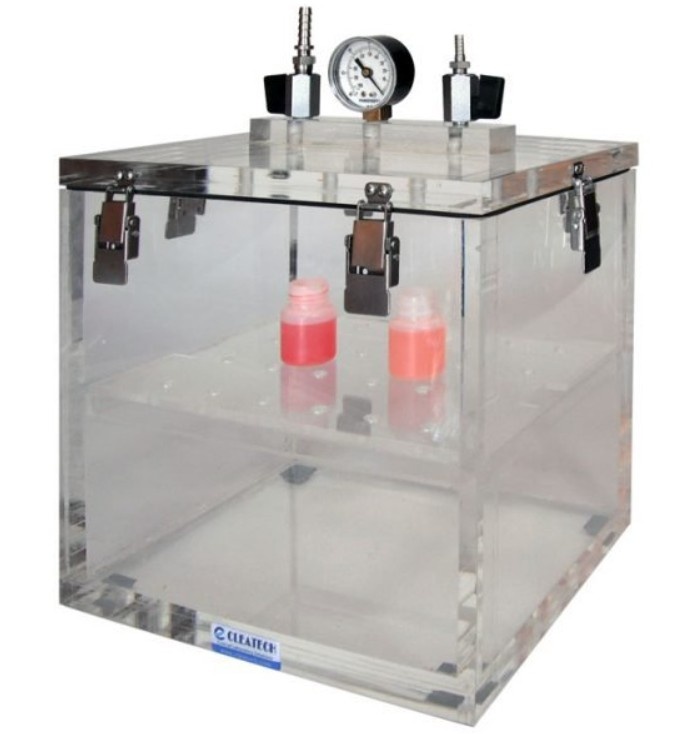
When comparing a vacuum desiccator for moisture-sensitive laboratory materials, examine these specifications:
Chamber dimensions: Confirm that the usable interior accommodates your samples, containers, and shelves.
Vacuum compatibility: Verify that the chamber supports the pressure conditions required by your process.
Sealing performance: Check the gasket, closures, valves, and connections for reliable sealing.
Sample accessibility: Choose between a removable lid and a front-access door based on your loading frequency.
Pressure monitoring: Consider a suitable vacuum gauge or control unit when your procedure requires repeatable pressure conditions.
Material compatibility: Ensure the chamber construction is appropriate for your chemicals, vapors, and operating environment.
For example, CleaTech’s 1300 Series includes clear acrylic vacuum chambers in different sizes and access configurations, with options such as additional shelves, vacuum gauges, pumps, and vacuum control units. Review the specifications of the individual model before making your selection.
Consider Safety, Maintenance, and Operating Costs
Vacuum desiccation requires more than selecting a chamber. You must account for safe operation, routine inspection, and any additional equipment needed to achieve your process goals.
Evaluate the following factors:
Vacuum safety: Use equipment rated for the intended vacuum conditions and inspect it for cracks, damage, or seal deterioration.
Chemical compatibility: Confirm that chamber materials, tubing, seals, and pump components are compatible with the substances involved.
Vapor management: Assess whether vapors require trapping, filtration, ventilation, or another approved control measure.
Maintenance requirements: Establish inspection schedules for seals, valves, tubing, gauges, and pumps.
Total operating cost: Include the chamber, pump, accessories, replacement parts, energy use, and staff training.
Never assume that a transparent chamber is suitable for every solvent or chemical. Follow the manufacturer’s operating instructions, relevant laboratory safety procedures, and applicable pressure-system requirements.
Validate the Process Before Full Implementation
A practical trial helps you determine whether vacuum desiccation delivers measurable improvements.
Begin with representative samples and a documented operating procedure. Record the initial sample condition, vacuum level, processing duration, temperature where relevant, and final results.
Compare these results with your existing method using predefined acceptance criteria. Check for residual moisture, changes in material properties, sample damage, and variation between repeated runs.
If the results meet your requirements consistently, establish standard operating procedures for loading, evacuation, monitoring, release of vacuum, and sample removal. If the results are inconsistent, investigate possible causes before investing in additional equipment.
Decide Whether Vacuum Desiccation Is the Right Fit
Vacuum desiccation is a strong candidate when your laboratory needs controlled low-pressure conditions for compatible samples, moisture-sensitive materials, degassing, or related vacuum applications. It may be unnecessary when passive humidity control already satisfies your requirements.
A simple decision checklist can help:
- Do you have a defined moisture-control or vacuum-processing objective?
- Are your samples compatible with reduced pressure?
- Can the chamber achieve your required operating conditions?
- Can you validate repeatable results?
- Can your laboratory operate and maintain the system safely?
If you answer yes to these questions, compare suitable equipment configurations and verify their specifications before purchasing.
CleaTech LLC provides laboratory and cleanroom equipment, including vacuum desiccator cabinets designed for a range of vacuum applications. Review the available models to identify a configuration that aligns with your laboratory’s process, sample dimensions, and operating requirements.
If you need help narrowing down your options, Contact us today to discuss your application and equipment requirements.
Frequently Asked Questions
1. What is vacuum desiccation used for in laboratories?
Vacuum desiccation is used for applications such as moisture-sensitive sample storage, drying compatible materials, degassing small components, and reducing air or moisture exposure under controlled vacuum conditions.
2. How do you know if your laboratory needs a vacuum desiccator?
Consider a vacuum desiccator if your process requires reduced-pressure conditions that a conventional desiccator cannot provide, or if testing demonstrates a need for improved moisture control or vacuum processing.
3. Is vacuum desiccation suitable for all laboratory samples?
No. Volatile compounds, pressure-sensitive materials, solvent-containing samples, and certain biological specimens may respond unpredictably to reduced pressure. Assess material compatibility and validate the procedure before routine use.
4. What should you consider when choosing a vacuum desiccator?
Evaluate chamber dimensions, supported vacuum levels, sealing performance, construction materials, sample access, monitoring options, pump compatibility, and maintenance requirements.
5. Can a vacuum desiccator improve drying consistency?
It can improve consistency when vacuum conditions are appropriate for the material and the process is controlled. Standardized loading, pressure settings, processing time, and validation are essential for repeatable results.
6. What is the difference between a vacuum desiccator and a conventional desiccator?
A conventional desiccator typically uses a desiccant or another humidity-control method to maintain a dry environment. A vacuum desiccator is designed to operate under reduced pressure, supporting specific drying, degassing, or low-pressure storage applications.
7. How can you maintain reliable vacuum desiccation performance?
Inspect seals and connections regularly, follow the manufacturer’s pressure limits, maintain compatible pump equipment, monitor operating conditions, and document process results to identify performance changes.