Choosing the right table for a controlled environment requires more than checking dimensions and price. Your table becomes part of the workspace where materials are handled, products are assembled, samples are prepared, or sensitive processes are performed. The wrong surface, frame, or design can make cleaning harder and introduce unnecessary contamination risks. By evaluating your environment, materials, construction, airflow, ergonomics, and maintenance requirements, you can select a cleanroom table that supports consistent and efficient operations.
Start With Your Cleanroom Requirements
Before selecting a table, define where and how you will use it. Consider the room classification, process requirements, cleaning procedures, operator activities, and materials handled on the surface.
For example, a table used for general assembly may have different requirements from one used in pharmaceutical processing, biotechnology, medical-device manufacturing, or semiconductor applications. Your table should complement the contamination-control practices already established in the room.
Also consider how frequently the surface will be cleaned. Frequent wiping and disinfecting can place greater demands on the table material and finish. Selecting a surface that tolerates your cleaning agents can help preserve its appearance and functionality over time.
Choose a Surface That Supports Easy Cleaning
Surface material is one of the most important considerations when selecting cleanroom tables for contamination-sensitive work areas.
Stainless steel is widely used because it provides a smooth, durable surface that can be cleaned easily. 304 stainless steel is commonly used for cleanroom and laboratory applications, while 316 or 316L stainless steel can be considered when greater corrosion resistance is required.
However, stainless steel is not your only option. Depending on your process, you may also consider:
- Epoxy resin for non-absorbent and corrosion-resistant applications
- Polypropylene where acid and caustic resistance is important
- Phenolic resin for chemical, abrasion, and impact resistance
- Static-dissipative surfaces for ESD-sensitive operations
Always check chemical compatibility with the substances and cleaning agents used in your facility before making a final decision.
Examine the Table’s Construction
A cleanroom table should minimize features that make cleaning difficult. Look closely at joints, seams, corners, fasteners, legs, and underside surfaces.
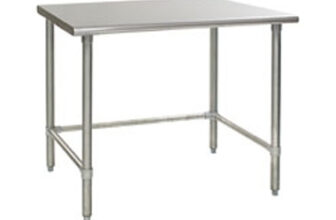
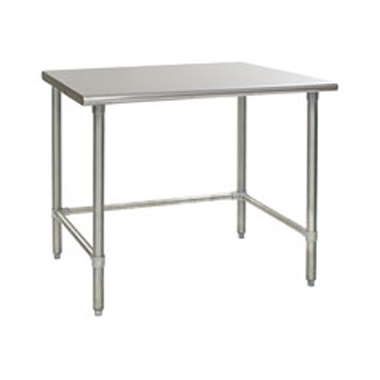
Smooth construction and rounded corners can make routine wiping easier. Fully welded designs can also reduce cracks and crevices where particles or residues may accumulate. Some cleanroom table designs use continuous welds and hygienic frames specifically to simplify cleaning and reduce contamination-harboring areas.
When comparing hygienic cleanroom tables for controlled laboratory environments, don’t evaluate only the tabletop. Examine the entire construction, including the frame and supporting components.
Decide Between Solid and Perforated Tops
Your process and airflow requirements should influence the tabletop design.
A solid tabletop provides a stable work surface and is practical for many laboratory, assembly, and sample-handling applications. It can also make it easier to contain small components such as vials, tubes, and other materials.
A perforated tabletop may be useful in environments where airflow beneath the work surface is important. Perforations can allow filtered airflow to pass through the surface and help reduce airflow obstruction.
Before selecting a perforated design, determine whether your process actually benefits from it. Don’t choose a configuration simply because it looks more specialized.
Match the Table to Your Workload and Space
Measure the available floor area before ordering. Account for equipment, operator movement, adjacent workstations, doors, aisles, and required clearance.
Then determine the load the table must support. Include the weight of equipment, containers, instruments, materials, and anything else that will remain on the surface.
Height is equally important. A fixed-height table may work well for a dedicated workstation, while adjustable legs can provide greater flexibility when different operators or processes use the same area. Adjustable workstations can also support different working heights and improve operator comfort.
For specialized applications, consider whether you need shelves, drawers, casters, leveling feet, or other accessories. Make sure every accessory is compatible with your contamination-control requirements.
Consider Cleaning, Maintenance, and Longevity
Your selection should support the cleaning program rather than complicate it.
Before purchasing, ask:
- Can you wipe every accessible surface easily?
- Is the finish compatible with your disinfectants?
- Are there exposed areas where residue can accumulate?
- Can the table withstand repeated cleaning?
- Are replacement components readily available?
- Will accessories create additional contamination-control challenges?
A durable table can provide value over years of repeated use, but durability should always be considered alongside cleanability and process compatibility.
For environments requiring rigorous contamination control, stainless steel cleanroom tables with easy-clean construction can provide a practical combination of durability, cleanability, and chemical resistance.
Choose Cleanroom Tables Based on the Complete Application
The best table is not necessarily the most expensive or the most heavily specified. Your goal should be to match the table’s material, construction, dimensions, airflow characteristics, load capacity, and accessories to the actual conditions of your controlled environment.
You can explore cleanroom tables for controlled environments and contamination-sensitive laboratory applications from Global Lab Supply to compare solutions for different workspace requirements.
If you need help determining which configuration fits your application, Global Lab Supply can help you evaluate suitable laboratory and cleanroom equipment options. You can also contact the cleanroom equipment team for application-specific guidance before making your selection.
FAQs About Cleanroom Tables
What material is commonly used for cleanroom tables?
Stainless steel is commonly used because it offers durability, a smooth surface, and good resistance to many cleaning processes. 304 stainless steel is widely used, while 316 or 316L may be appropriate when greater corrosion resistance is needed.
Are perforated cleanroom tables better than solid tables?
Neither design is universally better. Perforated tops can support airflow through the work surface, while solid tops provide a stable surface for many laboratory and assembly activities. Choose according to your airflow and process requirements.
What should you look for in a cleanroom table?
Evaluate surface material, construction, cleanability, dimensions, load capacity, height, airflow requirements, chemical compatibility, and accessories. Your table should support both contamination control and the practical needs of your operators.
Can cleanroom tables be used for ESD-sensitive applications?
Yes. Certain cleanroom tables are available with static-dissipative surfaces designed for environments where controlling electrostatic discharge is important. Confirm the required electrical properties and grounding arrangements for your application.
How do you maintain a cleanroom table?
Follow your facility’s approved cleaning and disinfection procedures. Use compatible cleaning agents, clean all accessible surfaces systematically, inspect joints and seams regularly, and replace damaged components that could compromise cleanability.